Locksmith in Saint-François, at the Tip of the Island
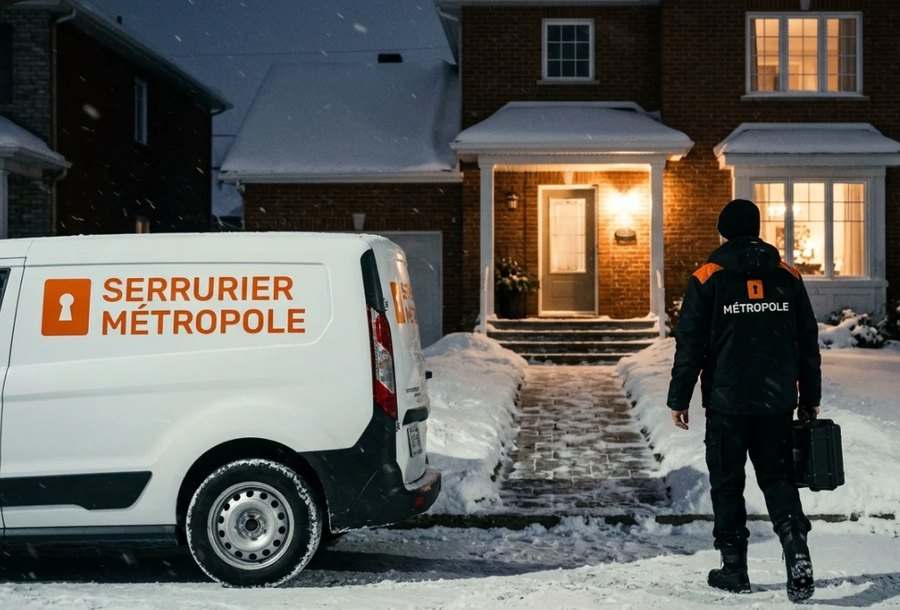
At the eastern tip of île Jésus, between two rivers, Saint-François keeps its fields, its rangs and its older houses, with a new neighbourhood rising in the southeast. The technician comes at any hour.
Our services in Saint-François
At the end of the island: fields, rangs and long distances
Saint-François occupies the eastern tip of île Jésus, between the rivière des Mille-Îles in the north and the rivière des Prairies in the southeast. It is a wide territory, with plenty of fields and woods, and houses of very different ages, sometimes kilometres of road apart. A farmhouse, an old house near the church, a bungalow in the south, a new house in the southeast: four doors, four ways of working.
For the technician, the distance between two addresses counts as much as the type of door. Give the civic number, the road and the nearest crossing; on a poorly lit stretch, an outdoor light left on or a description of the entrance keeps him from driving straight past.
Farmhouses and old wooden doors
Around the church of Saint-François-de-Sales and along boulevard des Mille-Îles, you still find older houses and farmhouses. Their doors are often solid wood, trimmed several times, with locks from different generations: an original latch handle, a deadbolt added later, a strike plate moved to follow a frame that shifted. Near the banks, a few former summer homes lived in year-round have kept a door lighter than the rest of the house.
On a door like that, the way in matters. The technician begins with methods that cause no damage, non-destructive entry, and moves to drilling only as a last resort. The guide opening a door without damaging it explains what happens at each stage. If the old lock can be saved, a lock repair avoids altering the door.
A farm has its secondary doors too: barn, workshop, machinery shed. These are often locks opened only in season, which rust and seize between uses. A little dry lubricant in the fall spares many stuck keys in spring.
The south: 1950s and 1960s houses
In the south of the area, most streets filled with houses in the 1950s and early 1960s. Calls there resemble those of older suburbs: a key that catches in a worn cylinder, a bolt that no longer extends all the way, a side door that locks only if you push it. When the mechanism is too tired, a lock change gives back a dependable door, ideally with a deadbolt that reaches deep into the frame.
On these houses the strike plate is often screwed into a thin wooden jamb with short screws. The technician takes the chance to fix it deeper into the structure: that is what decides whether a door withstands a shoulder charge.
The southeast, a neighbourhood taking shape
In the southeast, a residential zone is taking shape. In a brand-new house the lock is not worn; the question is who has had a key. Rekeying settles it without throwing away the builder's hardware.
It is also a good moment to think about all the doors together. A new house often has a front door, an inner garage door and a patio door, sometimes delivered with three different keys. If the locks are compatible, a single key can open them all. And if you are considering a keypad lock for the kids or for the contractor finishing the basement, have it fitted before the temporary site codes multiply.
Two rivers, two winters
Saint-François has water to the north and the southeast: boulevard des Mille-Îles follows the first river, boulevard Lévesque the second. Houses on the water take the wind, and exposed locks freeze more easily. Before the deep cold, a little graphite in the cylinder and a check of the door go a long way; the guide getting your locks ready before winter gives the list. If the key will no longer go in one January morning, the guide frozen lock says what to do, and above all what to avoid.
Montée Masson and Highway 25: the car at the roadside
Route 125, called montée Masson here, crosses the middle of the area and leads to Terrebonne over the pont Sophie-Masson; Highway 25 runs through the northwest. Montée du Moulin, boulevard Sainte-Marie and boulevard Marcel-Villeneuve complete the network. On these roads, a locked car at the edge of a field, far from any shop, quickly becomes a headache: give the nearest crossing and stay somewhere safe. Switch on the hazard lights if the car is on the shoulder. In winter, if the door is merely stuck with ice, do not haul on the handle with all your strength: the rubber seal tears, and the door shuts badly afterward.
Even at the end of the island, the technician most often arrives in under 30 minutes, and a service call starts from $45. Duvernay and Auteuil are a few minutes away, and the Laval page presents the other areas; the prices page explains what makes up the total.
Questions about Saint-François
My Saint-François farmhouse has an old wooden door. Will you damage it to get in?
The technician always tries to open without damage first: picking, or tools slipped between door and frame depending on the lock. Drilling comes only as a last resort, and it is explained to you beforehand. The guide opening a door without damaging it describes these methods.
I live on boulevard des Mille-Îles, far from the main streets. How will you find me at night?
Give the civic number and the nearest crossing, such as montée du Moulin or boulevard Sainte-Marie, and describe the entrance. An outdoor light left on helps a great deal on a poorly lit road.
I just bought in the new southeast neighbourhood. Rekey or replace?
If the locks are new and of decent quality, rekeying is enough to make the keys that circulated during construction useless. If they are too light, they get replaced.